
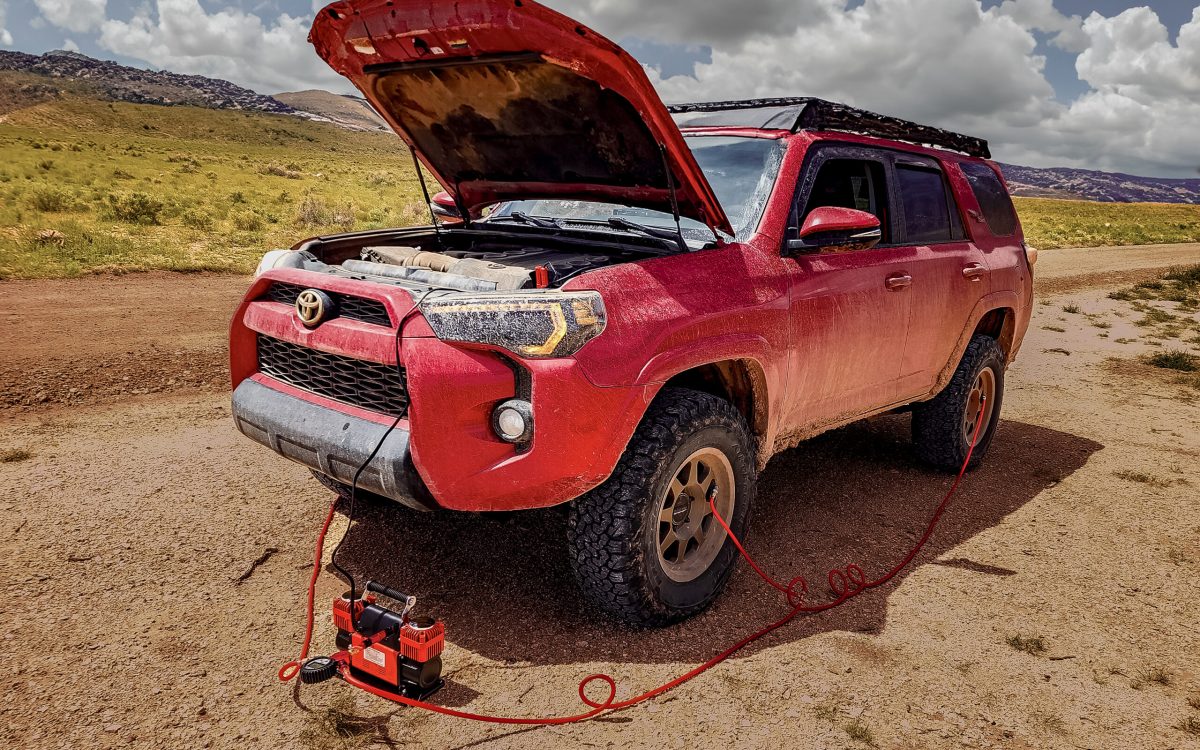
If you’re stepping into the world of off-roading for the first time or seeking to deepen your understanding of the essentials, this article is for you. While setting off on the trails with a capable vehicle is a great start, there are a few key items that can truly elevate your off-roading experience. We’ll cover the three must-know essentials to get you started in off-roading: airing down tires for better traction, airing up before hitting the pavement after a day on the trail, and choosing a radio for group communication on the trail. At the end, we’ll give you gear recommendations to tie this all together for a great off-roading experience.
Airing Down Tires
Airing down tire tires is a fundamental technique for enhancing traction and maneuverability on rugged terrain. Airing down is lowering your tire air pressure by defeating your tires by releasing air from the valve. Lower tire pressure on the trail allows for:
1. Improved Traction: Lowering tire pressure increases the surface area of the tire in contact with the ground, and allows for better grip and smoother rides over obstacles, enhancing traction on challenging off-road terrain.
2. Smoother Ride: Airing down tires absorbs shock more effectively, providing a smoother and more comfortable off-road driving experience for both the vehicle and passengers.
3. Reduced Risk of Damage: By allowing tires to conform to uneven surfaces, deflation helps minimize the risk of punctures, cuts, and damage to the tires when traversing rocky or rough terrain.
The graphic below illustrates the tire contact area at different levels of PSI (pounds per square inch). Normally, 4Runners maintain a PSI of 35-40 when driving on the street. As you deflate the tire for off-roading purposes, the tire becomes softer, allowing the tread to have increased contact with the ground.

When tackling dirt trails, having a larger surface area in contact with the ground is crucial. As the tire becomes squishier and flattens out, it maximizes contact with the ground. This increased contact translates to improved traction. Enhanced traction is key for navigating through trails and overcoming obstacles with confidence.
When it comes to airing down your tires for off-roading, there’s no one-size-fits-all approach. However, among the 4Runner off-road community, a common choice for moderate trails is around 15 PSI (pounds per square inch).
Of course, the ideal pressure can vary depending on factors such as terrain and personal preference. For challenging conditions like slick rock, difficult terrain, or very soft sand, you might opt to deflate your tires even further for better traction.
A good rule of thumb is to consult the recommendations provided by your tire manufacturer. They often offer guidance on the safe range for airing down your tires based on the specific design and construction of the tires. So, before hitting the trails, do your research and find the optimal pressure that suits both your vehicle and the terrain you’ll be tackling.
Methods for Airing Down
1. Cheap Method: Using tire gauges or small pin-shaped devices, you deflate each tire individually by holding down the valve core. While this method is slow, it’s simple and budget-friendly, making it suitable for beginners or those on a tight budget.
2. Rapid Air Down Deflator Gauge: This tool quickly releases air from tires by screwing down on the valve, providing swift deflation. It’s accurate and durable, but it requires expertise to prevent accidentally removing the valve stem, which could result in total deflation. It’s recommended for experienced users due to the potential risks for new users.
3. Valve Screw-on Deflators: Each deflator in the kit screws onto the valve stem of each tire, deflating them simultaneously and stopping once the preset pressure is reached. While easy to use, they can be a bit challenging to set up. It’s important to ensure each deflator is correctly set and that the tire stops at the preset pressure without continuing to release air.
4. Quad Hoses: Quad hoses connect to all four tires at once, equalizing air pressure and allowing a single gauge to measure the system’s pressure. This method releases air from all tires simultaneously, making it the fastest for deflation. Quad hoses are often included with high-power air compressor packages, making them the most expensive option.
Airing Up Tires
Before transitioning from off-road to back to pavement, airing up tires is essential. Equipped with an air compressor, off-roaders gain the flexibility to deflate tires as needed for terrain and the ability to reinflate back up before returning to paved roads.
Transitioning from off-road to back to pavement, airing up tires is crucial for off-roaders. Here’s why:
1. Restored Stability: Re-inflating off-road tires to their optimal pressure enhances stability and control on paved roads after off-road adventures. This ensures a smoother and safer ride for the journey home.
2. Increased Fuel Efficiency: Proper tire inflation reduces rolling resistance, which in turn improves fuel efficiency. By maintaining the right tire pressure, off-roaders can extend their vehicle’s range on long journeys and save on fuel costs.
3. Enhanced Tire Lifespan: Maintaining the recommended tire pressure prevents uneven wear and tear on off-road tires. This prolongs the lifespan of the tires, maximizing their performance and durability. By taking care of their tires, off-roaders can enjoy more adventures without worrying about premature tire replacement.
Selecting the right air compressor is crucial for off-roaders. Consider factors like portability, power source, air output capacity, size, and cost. Opt for a durable, portable model with sufficient PSI and CFM ratings to meet your tire inflation needs efficiently on the trail.
Air compressors typically run off of cables that are connected to the truck’s 12V battery. Some compressors have one hose that is taken to each tire to air up. Other compressors will have quad hoses, where each tire is connected simultaneously to the compressor, allowing for a single gauge to measure the system pressure. Other compressors might be permanently mounted somewhere in the truck, including under the hood, in the cab, or the rear. Another option for airing up is from a tank. Tanks can be carried, whether in the back of the truck or permanently mounted.
Selecting the right air compressor is a pivotal decision for off-roaders. Several factors come into play, including portability, power source, air output capacity, size, and cost. It’s essential to opt for a durable, portable model with sufficient PSI (pounds per square inch) and CFM (cubic feet per minute) ratings to efficiently meet your tire inflation needs on the trail.
Most air compressors run off cables connected to the truck’s 12V battery under the hood. Some compressors feature a single hose that can be taken to each tire individually for airing up. Alternatively, others come with quad hoses, allowing each tire to be connected simultaneously to the compressor. This setup enables a single gauge to measure the system’s pressure, streamlining the inflation process.
Additionally, some compressors can be permanently mounted in various locations within the truck, such as under the hood, in the cab, or in the rear. This offers convenience and accessibility, ensuring you always have a reliable air source when needed.
Another option for airing up is utilizing a tank. Tanks can be carried in the back of the truck or permanently mounted, providing an additional source of compressed air for inflation purposes.
Ultimately, when choosing an air compressor, prioritize reliability, efficiency, and convenience to ensure you’re well-equipped for any off-road excursion.
Group Communications - Radios
Radios play a vital role in group off-roading safety and communication. Handheld radios, in particular, foster real-time communication among group members, enabling coordination, sharing of information, and swift emergency response. It enhances group cohesion, keeping everyone informed and connected to enhance safety and prevent individuals from getting lost or separated. Whether it’s coordinating trail routes, sharing trail conditions, or responding to unforeseen situations, radio communication enhances the overall safety and camaraderie among off-road enthusiasts. Overall, radios significantly contribute to a more enjoyable group off-road experience by ensuring effective communication and connectivity throughout the journey.
The most common radio today for off-road groups is the GMRS handheld radio. GMRS, or General Mobile Radio Service, facilitates two-way communication over short to medium distances. Unlike FRS (Family Radio Service) radios, GMRS offers higher power and longer range. While primarily used for personal and recreational communications, it’s also used for business purposes. To legally use a GMRS radio, obtaining a GMRS license from the FCC (Federal Communications Commission) is required. This license covers you and your immediate family for personal non-commercial purposes. Obtaining the license is straightforward: visit the FCC website, agree to the rules and regulations, and pay a $35 fee.
When choosing a radio, look for simplicity, durability, quality, and ease of charging. Here’s what to look for:
1. Intuitive Design: Opt for radios with user-friendly interfaces and straightforward controls, especially vital for ease of use in challenging off-road conditions.
2. Reliable Construction: Choose radios known for their durability and quality craftsmanship, capable of enduring rugged off-road environments, and frequent use without compromising performance.
3. Convenient Charging: Prioritize radios that can be easily charged using common methods like USB or vehicle power outlets. This ensures hassle-free recharging during off-road trips, keeping you connected without interruption.
Choose a GMRS radio that is simple to use. When using a radio to communicate with a group, you will only be using a small amount of the radio functions. Prioritize ease of operation to ensure smooth and straightforward communication. Look for radios with the ability to change channels without the need for programming frequencies. You’ll typically only need to talk to the trucks in your group. Prioritize ease of operation to ensure smooth and straightforward communication.
If your intended use for your GMRS radio extends beyond truck-to-truck group communication, such as talking on repeaters or participating in GMRS clubs, opting for a radio with more functionality becomes necessary. While initially purchasing a handheld GMRS radio primarily for club communication, you may find yourself interested in expanding your usage over time. In such cases, upgrading to another radio with additional features when you’re ready is a viable option. After you upgrade, having your old radio to loan out to others is not a bad idea. I’ve found you can never have too many radios when you want to help out a newbie or when a buddy forgets theirs.
A short crash course in radio etiquette can be beneficial when communicating within a group. It assists in establishing effective methods for relaying information clearly and efficiently. For more detailed guidance on radio etiquette, check out my article dedicated to this topic. It provides valuable tips and guidelines to ensure smooth and respectful communication among members of your group during off-road adventures.
Conclusion
In conclusion, pumps, deflectors, and radios stand as indispensable tools for off-roading, playing pivotal roles in enhancing safety and enjoyment on the trail. New off-roaders are encouraged to invest in these essentials, as they contribute to a smoother and more enjoyable off-road experience. With the right tools and preparedness, off-roaders can confidently embark on their thrilling journey, equipped to conquer any terrain with ease.
Other Tips
Asking for Advice
One of the most valuable ways to learn about off-roading is
by hitting the trails with others and observing their techniques and equipment.
Ask fellow off-roaders about their methods for airing down, tools for airing
up, and choice of radios. However, exercise caution when considering
recommendations. While seasoned off-roaders may suggest premium products aimed
at advanced and frequent off-roaders, these may not necessarily suit your
needs. It’s essential to gather multiple opinions from various individuals and
inquire about the reasoning behind their recommendations. Avoid the frustration
of purchasing a product that doesn’t align with your experience level or
requirements by understanding how to use it effectively beforehand. Ultimately,
the goal is to gather insights and knowledge from others while making informed
decisions that best suit your off-roading journey.
How to chose
When it comes to choosing off-roading techniques and
products, there’s no substitute for real-world experience. The more you
off-road with others, the more you’ll be exposed to a variety of techniques and
products in action. Your best bet is to base your choices on what you observe
being used by people who share similar off-roading preferences and experiences
as you. Pay attention to what works well for others and consider how those
techniques or products might fit into your own off-roading style and needs. By
learning from the experiences of others who are like-minded, you can make more
informed decisions that align with your off-roading goals and preferences.
Borrowing
Before rushing to purchase off-roading products, consider
borrowing first. Borrowing allows you to research and test different products
before committing to a purchase, ensuring you make the best choice for your
needs. Many 4Runner owners are welcoming and accommodating, especially to
newcomers and those eager to try out equipment. When joining a group run for
the first time, don’t hesitate to ask if you can borrow air down and air up
products, or even a radio. Many off-roaders have extra radios on hand to offer
support to others. Take advantage of this opportunity to learn about different
products and make informed decisions without the pressure of immediate
purchases.
Links To Products
As an Amazon Associate, maybe someday I’ll earn a little something from the products purchased through these links to break even with the costs of running this blog. 😉 This is at no charge to you.

This heavy-duty air compressor is tailored for seasoned off-roaders seeking to significantly decrease inflation time by 200 to 300 percent. While this convenience is unparalleled, it comes with an increased price tag, weight, and space requirements compared to standard inflators. However, it’s considered a worthwhile upgrade by many enthusiasts. I highly recommend investing in quality hoses and avoiding cheaper knock-offs. In our experience, opting for subpar hoses has led to numerous instances of hose failure, resulting in potentially dangerous blowouts. It’s crucial to prioritize safety and reliability when selecting equipment for off-roading adventures.

This inflator is an excellent choice for beginners due to its ease of use, affordability, good quality, and compact size. It provides a straightforward solution for inflating tires without breaking the bank, making it ideal for those new to off-roading. Despite its low cost, it offers reliable performance and durability, ensuring that beginners can rely on it for their tire inflation needs. Additionally, its compact size makes it easy to store and transport, further enhancing its convenience for novice off-roaders. Overall, this inflator is a great entry-level option that offers a perfect balance of affordability, quality, and convenience for beginners.

The Vivir 300P model, a step up from the 88P, provides increased power for quicker air-up times. With enhanced performance, users can efficiently inflate tires in less time compared to the 88P model. This added power allows for faster and more convenient tire inflation, making it an excellent choice for those seeking improved efficiency during their off-roading adventures.

For the experienced off-roader who understands its operation, this tool efficiently and accurately airs down tires. It swiftly removes air from the tires by pulling the valve stem, allowing for precise control over the deflation process. This tool is designed for expert users who are knowledgeable about its operation and can utilize it effectively for rapid and accurate tire deflation during off-road excursions.

These original, high quality tire deflators offer a simple and precise method for airing down a vehicle’s tire pressure to a custom set PSI in just a few minutes. By screwing one deflator onto each tire, users can automate the process, eliminating the need for manual valve holding. This convenience not only speeds up the deflation process but also reduces strain on the back, making it an efficient and user-friendly solution for off-roaders.

These original, high quality tire deflators offer a simple and precise method for airing down a vehicle’s tire pressure to a custom set PSI in just a few minutes. By screwing one deflator onto each tire, users can automate the process, eliminating the need for manual valve holding. This convenience not only speeds up the deflation process but also reduces strain on the back, making it an efficient and user-friendly solution for off-roaders.

These tire deflators are affordable alternatives to the Staun Tire Deflators, available at a significantly lower price point. Despite being knock-offs, they have gained popularity among off-roaders due to their cost-effectiveness. Additionally, they have received mostly positive reviews, making them a popular choice for those seeking budget-friendly options for airing down tires.

This tire pressure gauge is easy to hold. Additionally, its built-in glass break tool serves as a convenient aid for airing down tires, by using the it to depress the tire valve.

The original old-school tire gauge and deflator is an extremely affordable option suitable for occasional use and ideal for new off-roaders who are still learning. While it may lack features, this gauge serves its purpose effectively for checking tire pressure and deflating tires when needed. Its simplicity makes it easy to use and a practical choice for those who may not require more advanced or expensive options. For beginners and occasional users, this traditional tire gauge and deflator provides a budget-friendly solution without compromising on basic functionality.

This radio is a popular choice among off-roaders of all levels due to its simplicity, durability, affordability, and convenient USB-C charging feature. It facilitates easy channel changes on the fly and allows users to toggle between two favorite channels with just the press of a button. While it offers the option to program frequencies, it’s not necessary for most users. Additionally, it boasts two useful features: the ability to set a “roger beep” to confirm successful transmission and a 15-second transmit limit to prevent excessively long transmissions for those long-winded individuals who lose track of time while talking. This limit ensures that emergency traffic has the opportunity break through promptly without waiting for extended transmissions to end.